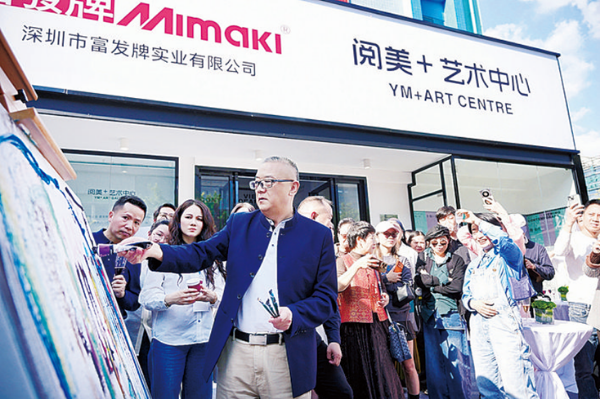
Longgang launches heartfelt 2026 "Chinese New Year Feast, Delivered with Warmth" campaign

    02-06,2026

    Dancers in red costumes perform energetically on the stage.Citizens experiences paper-cutting.An artist writes the character "Fu" (fortune) for attendees.Shenzhen's Longgang district inaugurated its 2026 "New Year Feast, Delivered with Warmth" care campaign on Feb 2 at the Renheng Dream Center, emphasizing its dedication to community welfare and social unity.The campaign was launched through an engaging, immersive street fair format. Attendees visited interactive zones, including a heritage alley showcasing traditional calligraphy and paper-cutting, a vibrant energy station with tech displays and games, and a community stage where professional performers shared the spotlight with local delivery riders. A memorable highlight was the Warmth Rest Stop, featuring an art installation of delivery boxes painted by local children alongside a wish wall for community hopes.The cornerstone of the launch was the presentation of the comprehensive 2026 Care Action Plan, which details 301 specific projects. These projects aim to develop a responsive "15-minute care service network" for vulnerable populations, enhance youth mental health and educational resources, and encourage civic etiquette.As a gesture of gratitude, "New Year Feast" gift packages were distributed to essential frontline workers. The event also featured inspiring talks from community role models, reinforcing the power of sustained kindness. Livestreamed online to ensure broad accessibility, this launch lays the groundwork for a year of meaningful action to build a more connected and compassionate district.

    Longgang Spring Festival Flower Fair to open in February

    02-05,2026

    The 2026 Longgang Spring Festival Flower Fair will be held from Feb 10 to 16 at the East Square of Shenzhen Universiade Center Stadium.This year's fair has expanded in scale, featuring around 260 diverse vendors offering everything from traditional festive flowers and cultural-creative products to specialty New Year goods from around the world, providing a one-stop shopping experience.Visitors explore the vibrant Spring Festival flower market.Centered on the "horse" as its core theme — symbolizing good fortune and success in the coming year — the fair will feature decorative arches and themed photo zones to enhance the festive atmosphere.The event is structured around three main highlights: a traditional market featuring flowers, couplets, and regional delicacies; a "Tech Innovation Zone" featuring AI installations, smart robots, and digital IP performances for an immersive tech-meets-culture experience; and a collaboration with the nearby Shenzhen Universiade World, hosting an inspiration-themed retrospective exhibition with Chinese New Year-themed installations for photo opportunities.By integrating traditional customs with modern technology, the fair reflects Longgang's commitment to innovating cultural consumption. In addition, temporary flower stalls will be set up in various neighborhoods for residents' convenience.A calligrapher writes the Chinese character "Fu" (blessing) with a brush on red paper.Red winterberry branches fill blue-and-white porcelain vases, creating a vibrant festive atmosphere for the holiday season.

    Guangdong's trade with APEC economies exceeds 6t yuan in 2025

    02-03,2026

    South China's Guangdong province purchased 1.72 trillion yuan ($242.25 billion) worth of mechanical and electrical products from APEC economies last year, marking a 13.7 percent year-on-year increase.The figure represented 73.2 percent of the province's total imports from APEC economies, said a statement released by Guangdong Customs on Friday.Among them, imports of integrated circuits surged to 987.35 billion yuan, a 19.6 percent year-on-year increase, while imports of computers and their parts reached 261.88 billion yuan, a year-on-year rise of 17.9 percent, the statement said.The steady growth of imports from APEC economies has helped Guangdong, China's biggest foreign trader, reach a total trade volume of more than 6.16 trillion yuan in 2025, up 3.3 percent year-on-year, the statement said.Guangdong's trade with APEC economies remained steady and upbeat in the previous year, it said.The province's exports to APEC economies hit 3.82 trillion yuan, a year-on-year increase of 1.1 percent, while its imports from those economies grew at an even faster rate of 8.7 percent year-on-year, totaling 2.34 trillion yuan.Hong Kong Special Administrative Region, the United States and Chinese Taiwan island were Guangdong's top three trade partners among APEC economies in 2025.Guangdong's trade volume with the three APEC economies reached 1.28 trillion yuan, 945.32 billion yuan and 833.08 billion respectively last year, accounting for nearly 50 percent of the province's total trade volume with APEC economies, it said.Private enterprises recorded 3.77 trillion yuan in trade volume with APEC economies last year, up 4.1 percent and accounting for 61.2 percent of the province's total trade volume with those economies, according to the statement.Foreign companies and joint ventures achieved 2.17 trillion yuan trade volume with APEC economies, accounting for a 6.2 percent rise year-on-year and representing 35.2 percent, a 0.8 percentage points increase from 2024.

    APEC meetings opportunity for region to strive for results-oriented consensus: China Daily editorial

    02-03,2026

     WANG XIAOYING/CHINA DAILYWhile it is the APEC economic leaders' meetings that grab the headlines, it is the work beforehand that prepares for these high-stake gatherings.That is why the first Asia-Pacific Economic Cooperation Senior Officials' Meeting and related events, hosted by China in Guangzhou from Sunday to Feb 10, deserve more attention than they are likely to receive.The meetings in Guangzhou, capital of Guangdong province, mark the opening act of the APEC "China Year" and the first official step toward the 2026 APEC Economic Leaders' Meeting, to be held in neighboring Shenzhen in November.Over 50 meetings of about 1,000 participants will discuss issues spanning trade, finance, digital rules, the green transition, supply chains and people-to-people exchanges. APEC is arguably one of the most practical platforms for regional economic cooperation in the world, and these preliminary gatherings function like workshops where agreements are hammered out and consensus is built.The theme China has put on the table as the host — "Building an Asia-Pacific Community to Prosper Together" — is pertinent to the region's pressing needs. Beijing has paired it with three operational priorities — openness, innovation and cooperation — which have been the hallmarks of the region's dynamism, but are now under immense strain.Although the Asia-Pacific remains one of the most dynamic engines of the global economy, it is navigating the rough seas of sluggish global growth, rising protectionism, fragmented supply chains, widening development gaps, accelerating climate and energy pressures, as well as the technological shock wave of artificial intelligence and the governance deficit.China's message in Guangzhou is clear: multilateralism and openness should prevail over unilateralism and protectionism. To that end, regional economies should focus on making the cake bigger rather than striving for the largest share of it.Over the past decades, average tariffs across APEC economies have fallen dramatically, and the region has been a major beneficiary of open trade. Yet today, trade barriers are creeping back. With 2026 marking the 20th anniversary of the vision of a Free Trade Area of the Asia-Pacific, China is urging APEC members to recommit to a World Trade Organization-centered multilateral trading system, deeper regional integration and stronger connectivity. The logic is simple: supply chains work best when they are linked, not weaponized. The regional economies should realize that no one can realize its own prosperity at the cost of others, or ensure its own "security" by making others "insecure".Innovation is the engine of future growth that regional economies can collaboratively foster. The Asia-Pacific is home to many of the world's most vibrant innovation hubs, but the benefits of digitalization and AI are unevenly distributed. China's proposal is not just to race ahead, but to widen the track: promote safe and orderly data flows, deepen cooperation on open-source technologies and bridge the digital and AI divide. Its idea of a World Artificial Intelligence Cooperation Organization reflects this. The proposal treats AI not as a geopolitical trophy, but as a global public good that needs shared rules, standards and literacy.The hosting of the APEC meetings in the heart of the Guangdong-Hong Kong-Macao Greater Bay Area is both symbolic and substantive. Now a global innovation hub, it embodies what happens when openness meets pragmatism and a pioneering spirit. China is signaling that it wants to share that experience with regional economies to promote sustainable common prosperity.Cooperation is where APEC's comparative advantage is evident. APEC operates through practical mechanisms: economic and technical cooperation, capacity building and sector-specific initiatives. China is encouraging the APEC member economies to continually use these tools to turn diversity into complementarity — whether in food security, energy, small and medium-sized enterprises, transportation, healthcare or human resources — so that no economy is left behind.Green development cuts across all of the three priorities where the APEC economies have broad common interests. China has built a large renewable energy system and has become a major supplier of new energy technologies. By funding APEC initiatives on digitalization for green transitions and supporting free flows of green technologies, the country is trying to align climate actions with growth, not pit them against each other.The Asia-Pacific is at a critical juncture. The broader choice facing the region is stark: solidarity and cooperation, or unilateralism and protectionism. History has shown which path works. Over the past more than 30 years, APEC has proved the rationality of openness and shared benefits. Abandoning that now would undo all the past efforts and be self-defeating.The Guangzhou meetings are down-to-earth preparations for not only the November gathering but also a more coordinated, cooperative and open APEC. They are about forging consensus within the region that striding together is possible — and worth the effort of overcoming differences.

    First official event of APEC 'China Year' is coming

    01-29,2026

    Guangzhou city. [Photo/IC]China will host the first Asia-Pacific Economic Cooperation Senior Officials' Meeting and related events from Feb 1 to 10, marking the first official event of the APEC "China Year" as the country prepares to hold the 33rd APEC Economic Leaders' Meeting in November.Speaking at a regular news briefing in Beijing on Wednesday, Foreign Ministry spokesman Guo Jiakun said that more than 50 events will be held during the meeting in Guangzhou, Guangdong province.About 1,000 representatives from APEC member economies, the APEC Secretariat and the APEC Business Advisory Council are expected to participate, Guo said, adding that preparations are progressing smoothly.The spokesman noted that APEC senior officials' meetings, which are held four to five times a year, serve as the main channel for preparing outcomes for the leaders' meeting, which will be held in Shenzhen, Guangdong province.As agreed by all APEC members, the theme for APEC in 2026 is "Building an Asia-Pacific Community to Prosper Together". To advance this vision, the APEC "China Year" has identified openness, innovation and cooperation as the three priorities for APEC this year.Guo said that the upcoming meeting will focus on the theme and the three priorities, fully launch cooperation across all fields and mechanisms, conduct in-depth discussions on specific cooperation initiatives, and accumulate outcomes for the economic leaders' meeting.Window to opening-upHe added that the host city of Guangzhou has a time-honored history and serves as an important window to learn about China's opening-up and a core city of the Guangdong-Hong Kong-Macao Greater Bay Area."We welcome friends from the media to follow and actively report on the first senior officials' meeting and related meetings to share the stories of the APEC 'China Year' with the world," Guo said.Since joining APEC in 1991, China has been a consistent advocate and active contributor to regional cooperation.This will be China's third time hosting the APEC Economic Leaders' Meeting, following the meetings in Shanghai in 2001 and Beijing in 2014.Those gatherings were instrumental in shaping regional economic integration, yielding the Shanghai Accord and the Beijing Roadmap for APEC's future development.From Shanghai to Beijing and to Shenzhen, China's role and contribution on the APEC stage has continued to strengthen, which shows China's efforts in spearheading Asia-Pacific cooperation, commitment to multilateralism and support for regional economic integration.

    China charts a new course for economic stability | News from Xinhua

    01-22,2026

    China's latest GDP figures show an economy holding firm in a troubled world. Growth in 2025 proved more resilient than many had expected. Yet the numbers point to something beyond mere endurance: they signal the early results of a strategic economic rebalancing that is increasingly the central theme of policy.As China enters the first year of its 15th Five-Year Plan (2026-2030), its economic trajectory is defined less by headline growth than by a move toward greater underlying stability and balance.Policymakers are fine-tuning their approach, prioritizing the expansion of domestic demand, strategic investment in human capital, and fostering innovation to build intrinsic stability for sustained development.STEERING STABILITYChina's economic policy is increasingly calibrated, favoring targeted support that can underpin long-term resilience over sweeping stimulus measures that risk fueling financial or sectoral imbalances."Evaluating 2026 requires a medium- to long-term view of structural change," said Wang Han of Industrial Securities. "The goal is to improve economic quality, not just chase a growth rate."The central bank's recent actions exemplify this nuance. While it implemented measured cuts to interest rates and mortgage requirements, analysts at Nomura described the moves as "low-profile easing", or careful adjustments designed to provide support without fueling excessive speculation in equity markets.On the fiscal front, Vice Minister of Finance Liao Min said Tuesday that fiscal spending will be further expanded this year, building on the proactive levels set for 2025. He emphasized that the ministry has fully taken into account the medium- to long-term sustainability of public finances, with a focus on strengthening future development. Efforts will be directed toward channeling more fiscal resources into boosting consumption, investing in human capital, and strengthening livelihood protection.To external observers, this represents a meaningful step toward economic maturity. "Recent policy signals tell a different story -- one of strategic transformation, resilience and sustained fiscal progress," noted Chris Sherrard, editor-in-chief of The Irish News, contrasting this with a foreign narrative preoccupied with the growth numbers.SHIFTING GEARSAchieving intrinsic stability necessitates a structural rebalancing. With the traditional engines of investment and export moderating or facing uncertainties, policymakers are turning to domestic consumption and technological advancement for sustained growth."China is at a critical phase in the transition from old growth drivers to new ones," noted Kang Yi, head of the National Bureau of Statistics. "Emerging growth drivers are gaining momentum, which will help counter downward pressure and create impetus for growth."Expanding domestic demand has been highlighted as a primary task for 2026, according to the Central Economic Work Conference held in December last year.Consumption, particularly in services, is slated to play a larger role in the economy. Analysts point to sectors such as elderly care, green technology, and cultural tourism as key areas of potential expansion.Wang Changlin, deputy head of the National Development and Reform Commission (NDRC), told a press conference Tuesday that China will formulate and release an implementation plan this year for its strategy to expand domestic demand for the 2026-2030 period.Alongside efforts to stimulate consumption, China is turning to innovation to drive productivity and future growth. Goldman Sachs notes that the country's long-term growth will rely more heavily on total factor productivity, with technologies like artificial intelligence expected to boost growth. Moody's also expects technology to propel industries ranging from advanced manufacturing to smart appliances, driving efficiency and supporting revenue.INVESTING IN PEOPLEParticularly noteworthy in China's evolving policymaking is the simple yet powerful idea of "investing in people." This framing treats human capital not merely as a social consideration, but as a fundamental input for sustainable, innovation-driven growth.The emphasis on "combining investment in physical assets and human capital," as reiterated in key policy documents such as the recommendations for formulating the 15th Five-Year Plan, reflects an understanding that long-term competitiveness requires nurturing talent alongside building infrastructure."'Investing in people' is crucial for addressing broad systemic challenges," said Zhang Jun of China Galaxy Securities. It represents, in his view, a strategy to simultaneously enhance public welfare and economic dynamism.This principle is beginning to inform specific policies. Deloitte noted in a research report that recent high-level discussions have identified increasing household incomes as the most effective lever to boost consumption -- a subtle shift from earlier approaches designed at subsidizing purchases.Zhou Chen, an official with the NDRC, said that authorities are formulating plans for stabilizing and expanding employment while enhancing job quality, as well as an initiative to raise the incomes of urban and rural residents.Noting that "investment serves as both immediate demand and future supply," Zhou said that the country will work to enhance the returns on investment, which can also directly translate into higher income for workers.The nation's demographic profile is also being reinterpreted as an asset. With the world's largest annual output of science, technology, engineering, and mathematics (STEM) graduates, this vast reservoir of talent is increasingly viewed as the driving force behind high-quality, innovation-driven growth."China's advantage is evolving from a 'population dividend' to a 'talent dividend'," noted Su Jian, director of China Center for Economic Research at Peking University.As China navigates the complexities of 2026, its focus on intrinsic stability through rebalancing may prove to be the defining feature of the country's next phase of development, and a measured response to the complex challenges ahead.  Notice:The above content is transferred from Xinhua, just for information sharing.We respect your intellectual property right and your other lawful rights. As any content here infringes any of your lawful rights, please contact us, and we will delete related content.

    Founding ceremony of Shenzhen University of Information Technology held

    01-15,2026

    On January 08, 2026, the founding ceremony of Shenzhen University of Information Technology was held, signifying the start of the undergraduate education programmes of the university.Brief profile of the university:Shenzhen University of Information Technology was permitted by the Ministry of Education on June, 2025 for the transformation and upgrading from the predecessor -- Shenzhen Institute of Information Technology, a vocational college founded on April 2002.Covering a land of 1387.4 mu, the university offers 57 majors related to ICT. It boasts the advantageous majors involving the integrated circuit, artificial intelligence, software technology, smart manufacturing, modern communication. On June 2025, the university, with permission, set up the 5 undergraduate education programmes of software engineering technology, modern communication engineering, integrated circuit engineering technology, intelligent manufacturing engineering technology, and embedded technology.The university attaches great importance to the integration of the school education and the industrial development, while developing in-depth cooperation with a series of enterprises in establishing the communities for the integration of industrial development and education, the industrial colleges, the senior engineers’ classes, the characteristic classes, to form the positive schooling ecology.The university successfully founds the new-type scientific institutes featuring the future industry technological institute, the AI college. It has established 17 scientific platforms at provincial/ministerial level or above, and established in cooperation with enterprises 13 research centers.Reference: official website of Shenzhen University of Information Technology; Shenzhen Special Zone Daily; Shenzhen EducationNotice: we respect your intellectual property right and your other lawful rights. As any content here violates any of your lawful rights, please contact us, and we will delete related content. 

    China aims for secure, reliable supply of AI core tech by 2027 | News from Xinhua

    01-08,2026

    China aims to achieve secure and reliable supply of key core artificial intelligence (AI) technologies by 2027, with its industrial scale and empowerment level remaining among the world's forefront, according to a recent government action plan.The plan, jointly issued by eight departments including the Ministry of Industry and Information Technology, the Cyberspace Administration of China, and the National Development and Reform Commission, outlines an ambitious push to deeply integrate AI with the manufacturing sector, foster new quality productive forces and comprehensively empower new industrialization.By 2027, the plan targets the deep application of three to five general-purpose large AI models in manufacturing, the development of specialized, full-coverage industry-specific large models, the creation of 100 high-quality industrial datasets, and the promotion of 500 typical application scenarios.It also aims to cultivate two to three globally influential ecosystem-leading enterprises, a batch of specialized and sophisticated small and medium-sized enterprises, and a group of enabling service providers proficient in both AI technology and industry know-how.Furthermore, China plans to build a world-leading open-source ecosystem, enhance security governance capabilities, and contribute Chinese solutions to global AI development.The document outlines measures including promoting the coordinated development of AI chips' hardware and software, supporting innovations in model training and inference methods, fostering key industry-specific large models, and deeply embedding large model technology into core production processes.The plan also emphasizes making breakthroughs in key technologies such as security protection for industrial model algorithms and training data protection.  Notice:The above content is transferred from Xinhua, just for information sharing.We respect your intellectual property right and your other lawful rights. As any content here infringes any of your lawful rights, please contact us, and we will delete related content.

    The 33rd Asia-Pacific Economic Cooperation (APEC) Economic Leaders’ Meeting to occur in Shenzhen (11.18-19, 2026)

    01-06,2026

    The 33rd Asia-Pacific Economic Cooperation (APEC) Economic Leaders’ Meeting is scheduled to take place in Shenzhen, Guangdong Province, during November 18-19, 2026.From December 11-12 of 2025, APEC Senior Officials’ Meeting was held in Shenzhen. It was the first event organized by China as the host of APEC 2026, which symbolized the start of APEC 2026 in China.With the theme of “building Asia-Pacific community and promoting the mutual prosperity”, APEC 2026 regards “openness, innovation and cooperation” as the 3 cooperation priorities of the year 2026. As for Asia-Pacific prosperity, “openness” is the lifeblood, “innovation” is the source of power, and “cooperation” is the foundation. The 3 cooperation priorities keep responsive to the demands from different sides.According to the schedule, about 300 APEC series events and activities would be held in different places of the host country -- China, across the year 2026. The 33rd APEC Economic Leaders’ Meeting would take place in Shenzhen from November 18-19, accompanied by the events like the APEC CEO Summit, the Diplomacy--Trade Sectoral Ministerial Meeting. APEC Senior Officials’ Meetings would be respectively organized in Guangzhou (in February, 2026), Shanghai (in May, 2026) and Dalian (in August, 2026). And starting from May of 2026, about 10 sectoral ministerial meetings / senior events would take place in different places of the host country, involving the sectors like trade, digital economy, transportation, tourism, human resources, SMEs, energy, food safety, finance, women’s rights, etc. Concerted efforts are being made for the activities and events.The APEC Senior Officials’ Meeting, held during December 11-12 of 2025, featured the visit activities, gaining the praise for the modernization in Guangdong -- Hong Kong -- Macao Greater Bay Area (GBA).Reference: XinhuaNotice: we respect your intellectual property right and your other lawful rights. As any content here violates any of your lawful rights, please contact us, and we will delete related content.