First official event of APEC 'China Year' is coming

    01 29, 2026

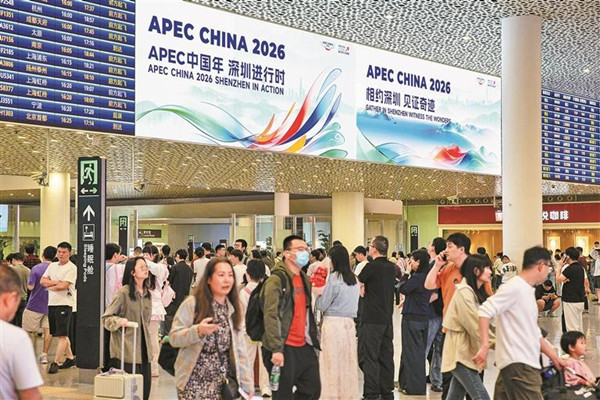
    Guangzhou city. [Photo/IC]China will host the first Asia-Pacific Economic Cooperation Senior Officials' Meeting and related events from Feb 1 to 10, marking the first official event of the APEC "China Year" as the country prepares to hold the 33rd APEC Economic Leaders' Meeting in November.Speaking at a regular news briefing in Beijing on Wednesday, Foreign Ministry spokesman Guo Jiakun said that more than 50 events will be held during the meeting in Guangzhou, Guangdong province.About 1,000 representatives from APEC member economies, the APEC Secretariat and the APEC Business Advisory Council are expected to participate, Guo said, adding that preparations are progressing smoothly.The spokesman noted that APEC senior officials' meetings, which are held four to five times a year, serve as the main channel for preparing outcomes for the leaders' meeting, which will be held in Shenzhen, Guangdong province.As agreed by all APEC members, the theme for APEC in 2026 is "Building an Asia-Pacific Community to Prosper Together". To advance this vision, the APEC "China Year" has identified openness, innovation and cooperation as the three priorities for APEC this year.Guo said that the upcoming meeting will focus on the theme and the three priorities, fully launch cooperation across all fields and mechanisms, conduct in-depth discussions on specific cooperation initiatives, and accumulate outcomes for the economic leaders' meeting.Window to opening-upHe added that the host city of Guangzhou has a time-honored history and serves as an important window to learn about China's opening-up and a core city of the Guangdong-Hong Kong-Macao Greater Bay Area."We welcome friends from the media to follow and actively report on the first senior officials' meeting and related meetings to share the stories of the APEC 'China Year' with the world," Guo said.Since joining APEC in 1991, China has been a consistent advocate and active contributor to regional cooperation.This will be China's third time hosting the APEC Economic Leaders' Meeting, following the meetings in Shanghai in 2001 and Beijing in 2014.Those gatherings were instrumental in shaping regional economic integration, yielding the Shanghai Accord and the Beijing Roadmap for APEC's future development.From Shanghai to Beijing and to Shenzhen, China's role and contribution on the APEC stage has continued to strengthen, which shows China's efforts in spearheading Asia-Pacific cooperation, commitment to multilateralism and support for regional economic integration.

    China charts a new course for economic stability | News from Xinhua

    01 22, 2026

    China's latest GDP figures show an economy holding firm in a troubled world. Growth in 2025 proved more resilient than many had expected. Yet the numbers point to something beyond mere endurance: they signal the early results of a strategic economic rebalancing that is increasingly the central theme of policy.As China enters the first year of its 15th Five-Year Plan (2026-2030), its economic trajectory is defined less by headline growth than by a move toward greater underlying stability and balance.Policymakers are fine-tuning their approach, prioritizing the expansion of domestic demand, strategic investment in human capital, and fostering innovation to build intrinsic stability for sustained development.STEERING STABILITYChina's economic policy is increasingly calibrated, favoring targeted support that can underpin long-term resilience over sweeping stimulus measures that risk fueling financial or sectoral imbalances."Evaluating 2026 requires a medium- to long-term view of structural change," said Wang Han of Industrial Securities. "The goal is to improve economic quality, not just chase a growth rate."The central bank's recent actions exemplify this nuance. While it implemented measured cuts to interest rates and mortgage requirements, analysts at Nomura described the moves as "low-profile easing", or careful adjustments designed to provide support without fueling excessive speculation in equity markets.On the fiscal front, Vice Minister of Finance Liao Min said Tuesday that fiscal spending will be further expanded this year, building on the proactive levels set for 2025. He emphasized that the ministry has fully taken into account the medium- to long-term sustainability of public finances, with a focus on strengthening future development. Efforts will be directed toward channeling more fiscal resources into boosting consumption, investing in human capital, and strengthening livelihood protection.To external observers, this represents a meaningful step toward economic maturity. "Recent policy signals tell a different story -- one of strategic transformation, resilience and sustained fiscal progress," noted Chris Sherrard, editor-in-chief of The Irish News, contrasting this with a foreign narrative preoccupied with the growth numbers.SHIFTING GEARSAchieving intrinsic stability necessitates a structural rebalancing. With the traditional engines of investment and export moderating or facing uncertainties, policymakers are turning to domestic consumption and technological advancement for sustained growth."China is at a critical phase in the transition from old growth drivers to new ones," noted Kang Yi, head of the National Bureau of Statistics. "Emerging growth drivers are gaining momentum, which will help counter downward pressure and create impetus for growth."Expanding domestic demand has been highlighted as a primary task for 2026, according to the Central Economic Work Conference held in December last year.Consumption, particularly in services, is slated to play a larger role in the economy. Analysts point to sectors such as elderly care, green technology, and cultural tourism as key areas of potential expansion.Wang Changlin, deputy head of the National Development and Reform Commission (NDRC), told a press conference Tuesday that China will formulate and release an implementation plan this year for its strategy to expand domestic demand for the 2026-2030 period.Alongside efforts to stimulate consumption, China is turning to innovation to drive productivity and future growth. Goldman Sachs notes that the country's long-term growth will rely more heavily on total factor productivity, with technologies like artificial intelligence expected to boost growth. Moody's also expects technology to propel industries ranging from advanced manufacturing to smart appliances, driving efficiency and supporting revenue.INVESTING IN PEOPLEParticularly noteworthy in China's evolving policymaking is the simple yet powerful idea of "investing in people." This framing treats human capital not merely as a social consideration, but as a fundamental input for sustainable, innovation-driven growth.The emphasis on "combining investment in physical assets and human capital," as reiterated in key policy documents such as the recommendations for formulating the 15th Five-Year Plan, reflects an understanding that long-term competitiveness requires nurturing talent alongside building infrastructure."'Investing in people' is crucial for addressing broad systemic challenges," said Zhang Jun of China Galaxy Securities. It represents, in his view, a strategy to simultaneously enhance public welfare and economic dynamism.This principle is beginning to inform specific policies. Deloitte noted in a research report that recent high-level discussions have identified increasing household incomes as the most effective lever to boost consumption -- a subtle shift from earlier approaches designed at subsidizing purchases.Zhou Chen, an official with the NDRC, said that authorities are formulating plans for stabilizing and expanding employment while enhancing job quality, as well as an initiative to raise the incomes of urban and rural residents.Noting that "investment serves as both immediate demand and future supply," Zhou said that the country will work to enhance the returns on investment, which can also directly translate into higher income for workers.The nation's demographic profile is also being reinterpreted as an asset. With the world's largest annual output of science, technology, engineering, and mathematics (STEM) graduates, this vast reservoir of talent is increasingly viewed as the driving force behind high-quality, innovation-driven growth."China's advantage is evolving from a 'population dividend' to a 'talent dividend'," noted Su Jian, director of China Center for Economic Research at Peking University.As China navigates the complexities of 2026, its focus on intrinsic stability through rebalancing may prove to be the defining feature of the country's next phase of development, and a measured response to the complex challenges ahead.  Notice:The above content is transferred from Xinhua, just for information sharing.We respect your intellectual property right and your other lawful rights. As any content here infringes any of your lawful rights, please contact us, and we will delete related content.

    Founding ceremony of Shenzhen University of Information Technology held

    01 15, 2026

    On January 08, 2026, the founding ceremony of Shenzhen University of Information Technology was held, signifying the start of the undergraduate education programmes of the university.Brief profile of the university:Shenzhen University of Information Technology was permitted by the Ministry of Education on June, 2025 for the transformation and upgrading from the predecessor -- Shenzhen Institute of Information Technology, a vocational college founded on April 2002.Covering a land of 1387.4 mu, the university offers 57 majors related to ICT. It boasts the advantageous majors involving the integrated circuit, artificial intelligence, software technology, smart manufacturing, modern communication. On June 2025, the university, with permission, set up the 5 undergraduate education programmes of software engineering technology, modern communication engineering, integrated circuit engineering technology, intelligent manufacturing engineering technology, and embedded technology.The university attaches great importance to the integration of the school education and the industrial development, while developing in-depth cooperation with a series of enterprises in establishing the communities for the integration of industrial development and education, the industrial colleges, the senior engineers’ classes, the characteristic classes, to form the positive schooling ecology.The university successfully founds the new-type scientific institutes featuring the future industry technological institute, the AI college. It has established 17 scientific platforms at provincial/ministerial level or above, and established in cooperation with enterprises 13 research centers.Reference: official website of Shenzhen University of Information Technology; Shenzhen Special Zone Daily; Shenzhen EducationNotice: we respect your intellectual property right and your other lawful rights. As any content here violates any of your lawful rights, please contact us, and we will delete related content. 

    China aims for secure, reliable supply of AI core tech by 2027 | News from Xinhua

    01 08, 2026

    China aims to achieve secure and reliable supply of key core artificial intelligence (AI) technologies by 2027, with its industrial scale and empowerment level remaining among the world's forefront, according to a recent government action plan.The plan, jointly issued by eight departments including the Ministry of Industry and Information Technology, the Cyberspace Administration of China, and the National Development and Reform Commission, outlines an ambitious push to deeply integrate AI with the manufacturing sector, foster new quality productive forces and comprehensively empower new industrialization.By 2027, the plan targets the deep application of three to five general-purpose large AI models in manufacturing, the development of specialized, full-coverage industry-specific large models, the creation of 100 high-quality industrial datasets, and the promotion of 500 typical application scenarios.It also aims to cultivate two to three globally influential ecosystem-leading enterprises, a batch of specialized and sophisticated small and medium-sized enterprises, and a group of enabling service providers proficient in both AI technology and industry know-how.Furthermore, China plans to build a world-leading open-source ecosystem, enhance security governance capabilities, and contribute Chinese solutions to global AI development.The document outlines measures including promoting the coordinated development of AI chips' hardware and software, supporting innovations in model training and inference methods, fostering key industry-specific large models, and deeply embedding large model technology into core production processes.The plan also emphasizes making breakthroughs in key technologies such as security protection for industrial model algorithms and training data protection.  Notice:The above content is transferred from Xinhua, just for information sharing.We respect your intellectual property right and your other lawful rights. As any content here infringes any of your lawful rights, please contact us, and we will delete related content.

    The 33rd Asia-Pacific Economic Cooperation (APEC) Economic Leaders’ Meeting to occur in Shenzhen (11.18-19, 2026)

    01 06, 2026

    The 33rd Asia-Pacific Economic Cooperation (APEC) Economic Leaders’ Meeting is scheduled to take place in Shenzhen, Guangdong Province, during November 18-19, 2026.From December 11-12 of 2025, APEC Senior Officials’ Meeting was held in Shenzhen. It was the first event organized by China as the host of APEC 2026, which symbolized the start of APEC 2026 in China.With the theme of “building Asia-Pacific community and promoting the mutual prosperity”, APEC 2026 regards “openness, innovation and cooperation” as the 3 cooperation priorities of the year 2026. As for Asia-Pacific prosperity, “openness” is the lifeblood, “innovation” is the source of power, and “cooperation” is the foundation. The 3 cooperation priorities keep responsive to the demands from different sides.According to the schedule, about 300 APEC series events and activities would be held in different places of the host country -- China, across the year 2026. The 33rd APEC Economic Leaders’ Meeting would take place in Shenzhen from November 18-19, accompanied by the events like the APEC CEO Summit, the Diplomacy--Trade Sectoral Ministerial Meeting. APEC Senior Officials’ Meetings would be respectively organized in Guangzhou (in February, 2026), Shanghai (in May, 2026) and Dalian (in August, 2026). And starting from May of 2026, about 10 sectoral ministerial meetings / senior events would take place in different places of the host country, involving the sectors like trade, digital economy, transportation, tourism, human resources, SMEs, energy, food safety, finance, women’s rights, etc. Concerted efforts are being made for the activities and events.The APEC Senior Officials’ Meeting, held during December 11-12 of 2025, featured the visit activities, gaining the praise for the modernization in Guangdong -- Hong Kong -- Macao Greater Bay Area (GBA).Reference: XinhuaNotice: we respect your intellectual property right and your other lawful rights. As any content here violates any of your lawful rights, please contact us, and we will delete related content. 

    China's economy poised to achieve annual growth target with steady November momentum

    12 16, 2025

    China's economy has maintained steady momentum in November, creating favorable conditions to achieve the annual growth target, as revealed by the latest economic indicators on Monday.Key economic indicators -- industrial production, retail sales and services -- extended gains last month, while employment continued its stable trend, according to the National Bureau of Statistics (NBS).Facing a complicated situation due to a changing external environment coupled with internal risks and challenges, China's economy has sustained steady progress supported by strong resilience, supportive macro policies and the expansion of new growth drivers, NBS spokesperson Fu Linghui told a press conference.In November, the country's value-added industrial output expanded 4.8 percent year on year. In the first 11 months, the industrial output increased by 6 percent.The retail sales of consumer goods, a major indicator of the consumption strength, rose by 4 percent year on year in the first 11 months, totaling 45.61 trillion yuan (about 6.45 trillion U.S. dollars). In November alone, retail sales of consumer goods went up 1.3 percent.The services sector also recorded steady expansion last month, with the services production index climbing 4.2 percent year on year, the data showed.On the job front, China's job market has remained generally stable, with the surveyed urban unemployment rate at 5.1 percent in November. For the first 11 months, the indicator was 5.2 percent on average.Speaking at the press conference, Fu highlighted the notable growth of new quality productive forces, which have injected fresh vitality into economic development.During the January-November period, the value-added output of the high-tech manufacturing sector increased by 9.2 percent year on year, while that of digital products manufacturing went up 9.3 percent.Notably, the production of industrial robots and integrated circuits surged by 29.2 percent and 10.6 percent year on year, respectively, in the first 11 months, according to Fu.China has targeted a full-year economic growth of around 5 percent this year. In the first three quarters, the economy grew by 5.2 percent.The sound momentum of China's economy is attributable to the precise implementation of more proactive and impactful macro policies, Fu said, adding that recent policy measures on boosting consumption, investment and the large-scale application of new scenarios will further strengthen the growth momentum.The spokesperson also noted that international organizations have recently raised their forecasts for China's growth, reflecting the international community's confidence in the country's economy.Looking ahead to the next year, Fu said China's economic foundation will remain solid, with numerous advantages, strong resilience and vast potential.The recent Central Economic Work Conference has set policy priorities and key tasks for economic work next year, Fu said, adding that China will continue to expand domestic demand, optimize supply and focus on securing the steady development of employment, enterprises, markets and expectations.These efforts are expected to lay a solid foundation for a good start to the 15th Five-Year Plan period (2026-2030), Fu said.Notice:The above content is transferred from Xinhua, just for information sharing.We respect your intellectual property right and your other lawful rights. As any content here infringes any of your lawful rights, please contact us, and we will delete related content.

    2025 Shenzhen International Artificial Intelligence Sanitation Robot Competition & Application Innovation Competition held in Longgang District of Shenzhen (Nov. 26-29)

    12 01, 2025

    2025 Shenzhen International Artificial Intelligence Sanitation Robot Competition & Application Innovation Competition was held at Shenzhen University of Information Technology in Longgang District of Shenzhen, from November 26-29.Over 40 sanitation-robot enterprises of the nation competed with each other in real urban scenarios, targeted at solving the industrial bottleneck problems and making technological innovation.The competition of this year is an upgrade from last session held in 2024, introduced by the organizing committee. With the “practical use” prioritized, this competition features the mechanism covering the “specialized tests, scenario innovation, and application innovation”. The competition of this year had assessment of the sanitation robots, sci-tech enterprises and urban-management services respectively from three dimensions, testing the performance, scenario breakthrough and practical application. With 88 testing spots, this competition is oriented to be “all-factor-inclusive”. Comprised of 115 tests, this competition is aimed at advocating the industrial researches and propelling the practical use, to set an example for the world.Centered on the core operational capacities of the sanitation robots, the specialized tests were divided into three categories in accordance with the actual application in parks and squares, on sidewalks and no-motor lanes and on auxiliary road. The sanitation robots must go through the dual assessment, with the open test held during Nov. 26-27 and the closed test during Nov. 28-29.Notably, the competition of this year specially had the open tests for the industrial innovation, to encourage enterprises to make technological breakthroughs in resolving the bottleneck problems at old streets and back alleys. And, the application innovation tests attached great importance to the system integration capacities of urban-management services, being mainly processed on the practical capacities like multi-robot collaboration and scheduling, AI recognition and reporting, data optimism and ordering.Reference: SZNEWSNotice: we respect your intellectual property right and your other lawful rights. As any content here violates any of your lawful rights, please contact us, and we will delete related content.