Scholars: Empowering youth for APEC economic integration

    05-09,2026

    The APEC Study Centers Consortium Youth Scholars Forum is in progress at the Chinese University of Hong Kong, Shenzhen on May 7, 2026, attracting youth scholars from 13 APEC economies. (PROVIDED TO CHINA DAILY)Youth scholars from Asia-Pacific Economic Cooperation (APEC) economies said that amid the turbulent international landscape, the younger generation has both the responsibility and the opportunities to contribute to regional economic integration through practical pathways.They made the call during the APEC Study Centers Consortium Youth Scholars Forum, held at the Chinese University of Hong Kong, Shenzhen, on Thursday. This year marks the third time that China is hosting the APEC meetings, including the summit scheduled for November in Shenzhen. The youth forum is one of a series of related activities taking place in the country.Speaking at a session on the role and actions of young people in driving regional economic integration, Mohd Hariszuan Bin Jaharudin, a researcher from the Institute of Malaysian and International Studies at the Universiti Kebangsaan Malaysia, said that the world is standing at a crossroads, where digital connectivity is at an all-time high, yet political barriers continue to rise.Amid the global shift toward anti-globalization and anti-multiculturalism, he believes that the cross-border mobility of young people seeking better development opportunities could be the key to reversing the trends.“As digital natives, they do not view borders as barriers, and see regional cooperation as an ecosystem of opportunities,” he said.He added that developing economies in the Asia-Pacific are home to over 580 million young people. According to a study by his team, 60 percent of youth in the Asia-Pacific region, particularly in Southeast Asia, are willing to move for a better future, skills training, and higher wages.Youth scholars attend the APEC Study Centers Consortium Youth Scholars Forum at the Chinese University of Hong Kong, Shenzhen, May 7, 2026. (PROVIDED TO CHINA DAILY)Jaharudin stressed that these young people place great importance on the quality of development opportunities, such as social protection in jobs, career advancement potential, and a sense of belonging to international and regional cross-border communities.He suggested that APEC economies draw on a mutual recognition arrangement for tourism professionals among the Association of Southeast Asian Nations and establish a similar cooperative framework to certify young people’s skills, protect their rights, and provide them with a sense of security as they cross borders."Our regional future is not just about the movement of goods, but the dignified movement of people," he said.During the same session, Lin Xiuxiu, a final-year PhD candidate in the Department of Economics at the University of Auckland in New Zealand, highlighted the younger generation's role in boosting the service trade.She noted that the service trade represents a growing part of global trade, especially in digitally deliverable service sectors, professional services, and services for individuals — such as education, healthcare, and some emerging creative industries.With greater adaptability to new business models and stronger cross-cultural skills, young people are well positioned to lead services trade integration within the APEC framework, she said.Lin added that many young people today are deeply involved in the region's economic integration and are driving the digitalization of the service trade through their innovation. She said that she advises them to further upgrade their skills — such as legal and regulatory literacy, digital security, and project management — to enhance the value of their services; and to actively engage in policy discussions to help shape more youth-friendly initiatives.Jhon Louie Bequiso Sabal, an assistant professor of economics at Xavier University in the Philippines, called on APEC members to pay greater attention to the development of remote regions in the context of economic integration and encouraged young people to participate in these efforts.He said that the Philippine economy has maintained rapid growth over the past decade; however, as a major population center, Mindanao remains plagued by high poverty rates, resulting in regional economic imbalances within the country.He said he believes that APEC should also be mindful of such internal development imbalances as it promotes economic integration. "Economic integration is not merely about opening up trade or participating in global value chains; the real challenge is whether all regions within a country can truly benefit from this process. Effective integration requires that benefits be distributed more widely, particularly to marginalized regions," he cautioned.The event attracted representatives of youth scholars from 13 APEC economies, specially invited scholars from Macao, as well as leaders from the political, educational, and business sectors.Contact the writer at bingcun@chinadailyhk.com

    First APEC youth scholars forum opens in Shenzhen

    05-08,2026

    The inaugural APEC Study Centers Consortium Youth Scholars Forum opens at The Chinese University of Hong Kong, Shenzhen on May 7.The first APEC Study Centers Consortium Youth Scholars Forum opened at The Chinese University of Hong Kong, Shenzhen on May 7, marking the first academic forum dedicated exclusively to young scholars in APEC's 37-year history. The event is a core program of "APEC China Year 2026."The two-day forum, running under the banner "Shaping New Drivers for Development: Youth, Innovation and a Sustainable Future", brought together young scholar representatives from 13 APEC economies, along with senior APEC Secretariat officials.Eduardo Pedrosa, executive director of the APEC Secretariat, noted that APEC's 21 member economies account for 37 percent of the global population and contribute around 61 percent of GDP. He said young scholars represent a wave of innovation that will inject new momentum into an open, dynamic and resilient Asia-Pacific future.Xu Yangsheng, president of The Chinese University of Hong Kong (Shenzhen), delivers a speech.Four parallel sub-forums were also held, covering AI and the digital economy, young people’s role in regional economic integration, education transformation in the AI era, and youth perspectives on a sustainable future. On May 8, participants were due to visit leading tech enterprises in Shenzhen for field research and dialogue, gaining firsthand insight into the city's innovation ecosystem.

    Shenzhen's robot craze becomes star attraction of May Day holiday

    05-06,2026

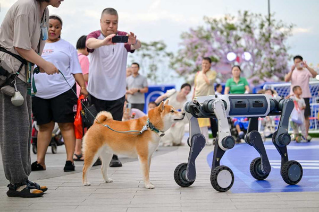
    Shenzhen, often referred to as the "City of Innovation" in South China's Guangdong province, has showcased its unique charm during the May Day holiday, with a series of captivating robot-themed events across the city.The Robot International Workers' Day event was held on May 1 at the robot 6S store in Longgang district, Shenzhen.The robot 6S store in Longgang district, claimed to be the world's first of its kind, serves as a one-stop shop for robot and component sales, maintenance, leasing and customized services. The location became a hub of immersive robot experiences, offering both a technological and culinary feast.The first robot restaurant experience store in Shenzhen opened its doors on May 1 on the fourth floor of the robot 6S store, featuring over 10 types of robots managing everything from welcoming guests to cooking and bartending. The simultaneous launch of the Robot International Workers' Day event included high-tech attractions like kung fu shows and piano performances, providing entertainment for the visitors.The first robot restaurant experience store in Shenzhen opened its doors on May 1 on the fourth floor of the robot 6S store, featuring over 10 types of robots managing everything from welcoming guests to cooking and bartending.During the holiday, the Shenzhen Talent Park in Nansha district and the areas adjacent to China Resources Tower, a landmark in the city, emerged as popular destinations for locals and tourists. The robot shows held in these locations captivated audiences, allowing individuals to experience the allure of AI up close during their leisure time.Robot show captivates audiences in Shenzhen during the May Day holiday.May 1 also marked the first anniversary of the Shenzhen Science and Technology Museum. This cultural landmark welcomed about 4 million visitors in its inaugural year and hosted nearly 10,000 public science activities. The anniversary celebrations featured a series of robot performances, further enhancing the city's reputation for embracing artificial intelligence and technological innovation.

    Shenzhen Design Week 2026 kicks off on April 27

    04-30,2026

    The Shenzhen Design Week 2026 commenced at the Longgang International Arts Center on April 27. The 10-day event features a host of activities, including the prestigious Kunpeng Global Design Awards, which have gathered 6,282 submissions from 20 countries and regions.The APEC China Year Shenzhen – City of Design Initiative was launched at the opening ceremony of the Shenzhen Design Week 2026 on April 27.Aligning with the priorities of the China Year of Asia Pacific Economic Cooperation – "openness, innovation and cooperation", the event aims to create an international platform integrating technological innovation, industrial collaboration and cultural exchange.A major highlight of the opening ceremony was the launch of the APEC China Year Shenzhen- City of Design Initiative, which saw participation from multiple metropolises that have been dubbed City of Design to promote enhanced international design cooperation among APEC member economies.The 2026 Kunpeng Global Design Awards announced the gold award winners in the categories of Urban Design, Industrial Design, and Visual Communication.With a total prize pool of 4 million yuan ($584,000), the Kunpeng Global Design Awards cover five categories, including urban design, industrial design and digital design. This year’s submissions show an increase of over 1,000 entries from the previous year, with AI technology emerging as a notable highlight.The Shenzhen Design Week 2026 commenced at the Longgang International Arts Center on April 27.In a significant move, Shenzhen signed a strategic cooperation agreement with the London Design Festival to support the global expansion of the "Shenzhen Design" brand. The event also includes a Global City of Design Roundtable Dialogue, a Global Designers Conference and five industry matchmaking conferences.As China's first "City of Design" recognized by UNESCO in 2008, Shenzhen continues to drive industrial upgrades and urban development through design innovation. This year's design week leverages the APEC meeting to foster international exchange and industry collaboration, reinforcing its international standing as a "City of Design."

    Shenzhen Design Week opens at Longgang's new cultural landmark

    04-28,2026

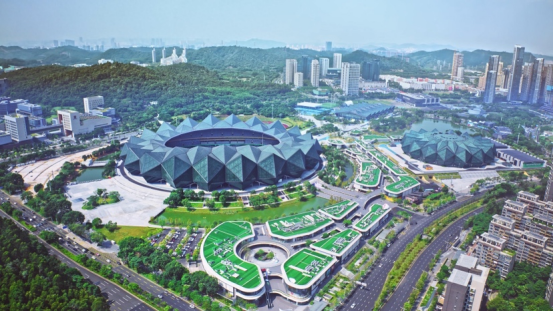
    The 2026 Shenzhen Design Week and the Global Design Award "Kunpeng Award" opened on April 27 at the Longgang International Art Center. This newly unveiled cultural landmark embodies the city's "technology plus art" vision.Longgang International Art Center, a newly emerging cultural landmark in Shenzhen.The center boasts a total floor area of 110,000 square meters and is recognized as a benchmark for smart cultural venues in the Greater Bay Area. It features a 1,500-seat opera house, a 554-seat theater and a 305-seat concert hall, all equipped with 5G-enabled immersive technologies. In addition, the venue includes the 17,000-square-meter D+ Digital Art Gallery, which comprises five signature spaces that offer LED giant screens, holographic imaging and real-time interactive experiences.The audience is enjoying the integrated performance in the holographic space.Powered by HarmonyOS, the center — China's first "Harmony Theater" — features augmented reality navigation, virtual reality seat selection and 8K live streaming capabilities. Its design integrates indoor and outdoor spaces, anchored by a 5,000-square-meter "urban living room" that connects to a neighboring park.The center itself serves as the most compelling exhibit of the design week. At its entrance, a permanent art relief combining Eastern and Western music history welcomes visitors. With its boundary-free public spaces, the center exemplifies Shenzhen's commitment to incorporating design into everyday urban life.The artistic relief wall depicts the historical trajectory of music from both Eastern and Western cultures.The Kunpeng Award received over 6,200 entries from 20 countries and regions this year, with AI technologies now forming a mature backbone of many submissions. During the ceremony, a strategic partnership with the London Design Festival was signed, underlining Shenzhen's global design ambitions. The event runs through early May.

    Inaugural national AI operator testing competition concludes in Shenzhen

    04-27,2026

    The inaugural national artificial intelligence operator testing competition was held on April 25 and 26 at The Chinese University of Hong Kong, Shenzhen, and Shenzhen University of Information Technology in Longgang district of Shenzhen in South China's Guangdong province.Participants of the inaugural national AI operator testing competition, which was held in Longgang district of Shenzhen in South China's Guangdong province on April 25 and 26, pose for a group photo.The competition attracted 751 teams comprising 1,057 students from 311 universities nationwide. After rigorous selection, approximately 70 elite teams advanced to the finals for a showdown.Ultimately, 36 outstanding teams emerged victorious. A team from Tianjin University won the grand prize with an award of 15,000 yuan ($2,192), while teams from Guangzhou University, Anhui Normal University, Nanchang Hangkong University, and China University of Geosciences (Wuhan), among others, won first prizes of 10,000 yuan each.The finals of the inaugural national AI operator testing competition is in progress.Operators, intelligent systems that orchestrate AI agents and workflows to boost business automation and efficiency, are the "cornerstones" of AI applications. This competition aimed to identify and cultivate top-tier foundational software talent capable of overcoming critical technological challenges, thereby injecting momentum into the sustainable development of China's AI computing ecosystem.Participants engaged with cutting-edge AI technology, utilizing Huawei's Ascend AI processors and the CANN (Compute Architecture for Neural Networks) software platform to conduct in-depth testing, defect localization, and performance analysis of key operators.An AI achievements exhibition is held in Longgang district of Shenzhen.The decision to host the finals in Longgang district was of strategic significance, as the district boasts comprehensive ICT industrial chain – from chip design and semiconductor manufacturing to smart terminals and industrial internet.Currently, Longgang is vigorously advancing its "All in AI" strategy, with over 12,700 AI and robotics companies forming a complete industrial chain, thus offering abundant "test fields" for AI technology.

    Global AI Entrepreneurship Competition to kick off in Shenzhen's Longgang district

    04-24,2026

    Poster of 2026 WAIC Future Tech OPC Independent Pioneer Challenge.A flagship artificial intelligence competition designed for the era of "solo entrepreneurs" is set to take off in Longgang district, Shenzhen, with the district securing the hosting rights for the 2026 WAIC Future Tech OPC Independent Pioneer Challenge South China Division.The event, overseen by the World Artificial Intelligence Conference (WAIC) Committee, is tailor-made for "one-person companies" and "super individuals." It breaks away from traditional startup contests by removing barriers such as mandated full teams and lengthy business plans. Participants need only submit a demo showcasing an original AI product's usability and commercial potential.Shenzhen Longgang Data, the official division host, will leverage the competition to implement the district's "ALL in AI" strategy. The event features a streamlined three-stage path: an online screening round in April to select 200 global semi-finalists, the South China division finals in Longgang this May, and the national grand final in Shanghai in July.A comprehensive incentive package valued at over one million yuan awaits contestants nationwide. Exclusive benefits for the Shenzhen division include three months of free computing power, up to 18 months of subsidized office space, two months of free accommodation, and talent settlement subsidies of up to 100,000 yuan ($14,630).These benefits are further complemented by Longgang's local "AI Ten Measures" policy, which offers extra computing subsidies, open public data access, and significant cost reimbursements on hardware and digital tools.To help candidates prepare, Longgang Data will host briefing sessions and entrepreneurship talks in the coming weeks, aiming to build a fast track for South China's AI innovators onto the global stage.