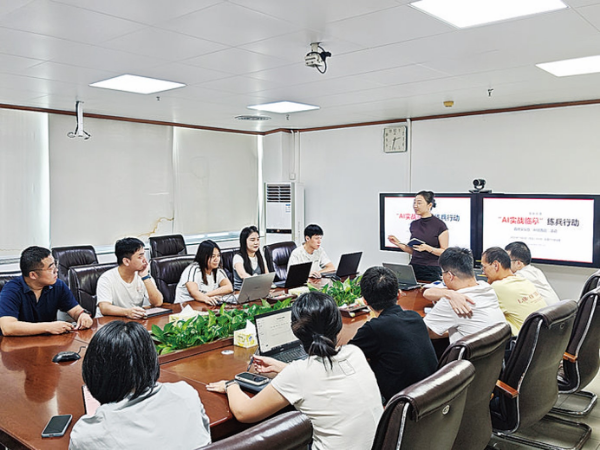
Officials attend a hands-on AI training session at the event.
Longgang subdistrict, an administrative unit under Longgang district in Shenzhen city, has launched an "AI practical imitation" training program to help local officials move from merely hearing about AI to actually using it in their daily work, with the first hands-on session held recently.
At the event, 12 young officials served as "AI pacesetters", using task cards to build, customize and test their own AI workstations within 30 minutes. The program adopts an "imitation" approach, comparing learning AI to tracing calligraphy, and sets a three-step process: copy, modify and apply. Participants first follow scripts to produce AI results quickly, then modify the workstations to fit at least three aspects of their actual jobs, and finally use them in real work for two weeks.
To address the common issue of officials being motivated during training but struggling to apply what they've learned afterward, the task cards break down AI workstation setup into four steps: creating a workspace, inputting prompts, personalizing the setup, and running tests. The scripts are designed so that officials with zero programming background can easily get started.
The training focuses on achieving practical results rather than on appearance or rankings. Participants are required to submit screenshots and usage comparisons as their assignments. Each "AI pacesetter" is responsible for training colleagues and collecting frontline challenges for the organizing team to address.
The program runs from mid-Nov to mid-Jan of the following year, with a new imitation task released every half month. It also includes achievement exhibitions and imitation competitions, aiming to compile a set of replicable, practical AI tools.