Longgang district has put in place an efficient intelligent logistics model featuring daytime last-mile delivery and nighttime warehouse network replenishment.
From full-district road right opening to multi-scenario application and infrastructure empowerment, the district has built a benchmark for intelligent logistics through all-round innovation, continuously fueling the high-quality development of Shenzhen's smart city initiative.
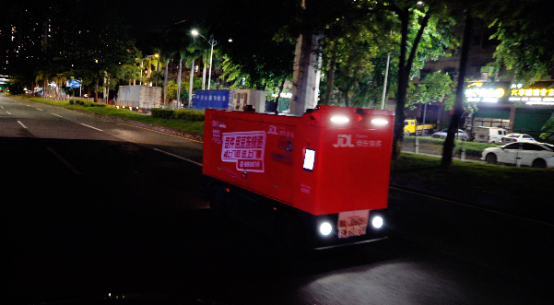
JD Logistics runs almost 100 autonomous delivery vehicles across Shenzhen, with nearly 40 operating in Longgang district.
Under the guidance of Shenzhen Municipal Transportation Bureau, Longgang took the lead in fully opening nighttime road rights for functional autonomous vehicles across the district, effectively tackling long-standing industry pain points including saturated daytime traffic flow and constrained capacity for autonomous deliveries.
After two years of on-site trial operation and refinement, the district released a complete set of administrative measures for autonomous vehicles in July, establishing full-process norms covering vehicle access, road passage, safety supervision and operational support.
On March 26, a municipal-level policy granted cross-district freight passage rights for autonomous vehicles in Pingshan and Longgang districts from 10 pm to 6 am daily. Policy dividends rapidly translated into industrial growth: within merely three months, the number of nighttime autonomous delivery routes citywide jumped from an initial two to 331, with over 100 vehicles deployed. Total nighttime driving mileage exceeded 40,000 kilometers in June.
Longgang has also rolled out supporting infrastructure and pioneered a collaborative system for autonomous logistics with local state-owned enterprises. The district led the integration of eastern bus groups with logistics and autonomous vehicle firms, renovating existing bus stations to build exclusive charging and refueling depots and regional transit hubs for autonomous vehicles. This enables the multi-purpose station utilization and unified administration of logistics resources, ensuring the round-the-clock stable operation of autonomous vehicles.
By day, autonomous vehicles mainly handle cargo transshipment within subdistricts: couriers depart with primary batches of goods for door-to-door delivery, while remaining parcels are transported to subdistrict stations in batches by autonomous vehicles. This completely resolves past bottlenecks such as limited single-load capacity and frequent return trips to replenish inventory at service outlets.
Off-peak nighttime operation has generated substantial multiplier effects for the logistics sector. Single-vehicle operating costs dropped by roughly 20 percent, and capacity utilization rose by 66 percent. Improved efficiency ultimately benefits consumers across the city.