SZ: China's cradle for women's ice hockey

    07 27, 2022

    window.__styleInject__ = window.__styleInject__ || function (css) { if (!css) return; if (typeof (window) == 'undefined') return; var style = document.createElement('style'); if ('styleSheet' in style) { style = document.createElement('div'); style.innerHTML = 'x' + css + ''; style = style.lastChild; } else { style.innerHTML = css; } var head = document.getElementsByTagName('head')[0]; head.appendChild(style); return css; }; window.__resetPlayerOpt__ = window.__resetPlayerOpt__ || function (opt) { opt.width = opt.width ? (opt.width + '') : '100%'; opt.height = opt.height ? (opt.height + '') : '300px'; if (opt.width.indexOf('%') === -1 && opt.width.indexOf('px') === -1) { opt.width = opt.width + 'px'; } if (opt.height.indexOf('%') === -1 && opt.height.indexOf('px') === -1) { opt.height = opt.height + 'px'; } if (!!window.navigator.userAgent.match(/AppleWebKit.*Mobile.*/)) { if (opt.custom_priority) { if (opt.width && typeof opt.width === 'string' && opt.width.indexOf('%') > -1) { window.__styleInject__('div#' + opt.id + '.prism-player.video.nfw-cms-video { width: ' + opt.width + ' !important; height: ' + opt.height + ' !important; }'); } else { var __pdom = document.getElementById(opt.id); var pwidth = __pdom.parentElement.offsetWidth || document.body.offsetWidth; opt.height = window.parseInt(opt.height) / window.parseInt(opt.width) * pwidth + 'px'; opt.width = '100%'; window.__styleInject__('div#' + opt.id + '.prism-player.video.nfw-cms-video { width: ' + opt.width + ' !important; height: ' + opt.height + ' !important; }'); } } else { opt.width = '100%'; } } else { if (opt.custom_priority) { window.__styleInject__('div#' + opt.id + '.prism-player.video.nfw-cms-video { width: ' + opt.width + ' !important; height: ' + opt.height + ' !important; }'); } } return opt; }; window.__cms_video_player_instances__ = window.__cms_video_player_instances__ || []; window.__cms_viedo_player_opts__ = window.__cms_viedo_player_opts__ || []; var playerOpt = {"id":"video_18058384622505376","source":"{\"LD\":\"https:\\\/\\\/gdvideo.southcn.com\\\/2c72bca9d3a646adb028f45b8867935e\\\/ab78b9c693f24454bf7c55316e1f60c0-7d9fa4f9ad2212716038d85286d2b81d-ld.mp4\",\"SD\":\"https:\\\/\\\/gdvideo.southcn.com\\\/2c72bca9d3a646adb028f45b8867935e\\\/ab78b9c693f24454bf7c55316e1f60c0-8558f648b0b62a1ec8bfe498e30b3545-sd.mp4\"}","qualitySort":"asc","format":"mp4","mediaType":"video","cover":"https:\/\/www.lg.gov.cn\/video\/0\/5\/5639\/9984081_c59392.jpeg","autoplay":false,"isLive":false,"rePlay":false,"playsinline":true,"preload":false,"language":"zh-cn","controlBarVisibility":"hover","useH5Prism":true,"custom_priority":false,"height":"540px","width":"100%","custom_height":"1080px","custom_width":"1920px"}; playerOpt = window.__resetPlayerOpt__(playerOpt); if (!window.addEventListener) { playerOpt.useFlashPrism = true; } else { playerOpt.useH5Prism = true; playerOpt.cover = "https://www.lg.gov.cn/video/0/5/5639/9984081_c59392.jpeg"; } window.__cms_video_player_instances__.push(new Aliplayer(playerOpt)); window.__cms_viedo_player_opts__.push(playerOpt); Video and photos by Wang Haolan except otherwise statedThe 2021-2022 season was a big year for Chinese women's ice hockey.The Chinese team returned to the Winter Olympics for the first time in 12 years, and made it back to Division I Group A at the World Championships with an unbeaten run in Group B during an 11-year period.Members of the Chinese women's ice hockey team celebrate at a group match between China and Japan at Wukesong Sports Centre in Beijing on Feb. 6 during the 2022 Olympic Winter Games. China DailyBehind these achievements are the five years of persistent dedicated effort by the Shenzhen-based Kunlun Red Star (KRS) hockey club.KRS is China’s first professional hockey club, which was founded in Longgang District in 2017 to nurture female players to represent China at the Beijing Winter Olympics. Early this year, it sent 16 players to the national team.Zhu Rui (L) and Liu Zhixin, who are players of Kunlun Red Star Vanke Rays Shenzhen, pose for a photo holding the trophy of the 2021-2022 season of Russia's Kontinental Women's Hockey League.While talking about why Shenzhen was chosen, Ao Meng, chairwoman of KRS, explained, “We visited many city candidates but Shenzhen was the best choice, as the local government offers preferential policies and the city has a young population that would like to experience niche sports like ice hockey.”Ao Meng, chairwoman of Shenzhen Kunlun Red Star (KRS) ice hockey club, has an interview with Shenzhen Daily. Lin Jianping"As an economic powerhouse, Shenzhen is able to provide sufficient funding for winter sports, which is relatively expensive," she added.With the support of the Longgang government, the club built an Olympic-standard ice hockey training base, including a 60-meter-long and 26-meter-wide hockey rink, the only one of its kind in South China.A scene at KRS's inflatable ice hockey stadium in Longgang District.To improve the skills of homegrown female players, the club formed a combination of the best Chinese talents seasoned with some international stars and sent the team to compete in international ice hockey leagues.Before KRS, women's ice hockey was a lesser-known sport with a limited fan base in China, and its athletes had to face a series of difficult challenges, such as the lack of access to overseas professional competitions and the shortage of financial support.The exterior of KRS's inflatable ice hockey stadium.Joining the club is recognized by its players as a turning point in their careers. "When I came to Shenzhen, everything was perfect, including the weather, the ice hockey stadium, the food and the accommodations. Now, I can play games abroad, earning salaries and bonuses," said Liu Zhixin, a defender of KRS Vanke Rays.Liu Zhixin (L), a defender of Kunlun Red Star Vanke Rays Shenzhen, in action against a player from SKIF Nizhny Novgorod Hockey Club at the finals of the 2021-2022 season of Russia's Kontinental Women's Hockey League. Photo courtesy of KRSSince its establishment in 2017, KRS had participated twice in the Canadian Women’s Hockey League and has been playing in Russian Women’s Hockey League (WHL) for three seasons.This April, the club was crowned in the 2021-2022 season, winning a second WHL trophy.Liu Zhixin (In the lower right corner of the photo) drinks champagne from the trophy after the award ceremony of the 2021-2022 season of Kontinental Women's Hockey League. Photo courtesy of KRSFor 29-year-old Liu, the past year has been a big success: "Playing at the Winter Olympics for the second time, the World Championships and then winning the second WHL title, every single step is not easy. This year marks a milestone in Chinese women’s hockey. We are moving step by step toward joining the world’s top echelon of teams."Zhu Rui, a 24-year-old forward, showed unyielding mettle in her debut at the Winter Olympics. She recalled that some of her teammates were injured in a hard-fought match against Japan, but “we still held together, overcame adversity and finally won the game.”Zhu Rui, a forward of Kunlun Red Star Vanke Ray Shenzhen, in action against a player from SKIF Nizhny Novgorod Hockey Club at the finals of the 2021-2022 season of Kontinental Women's Hockey League. Photo courtesy of KRSAlthough these games were held out of town, the Shenzhen club kept a close eye on its players. The club’s managers, along with a new generation of Chinese players, watched live matches at the Longgang training base, cheering for their players’ victories and wailing over their defeats.An outfit worn by members of the Chinese national teams at the opening ceremony of the 2022 Olympic Winter Games is displayed in the club. "Our job is to inspire a new generation of young girls and boys to play hockey and make ice hockey a poster-child sport for Shenzhen," said Ao.

    School of Music CUHK, SZ presents chamber concert in Longgang

    06 13, 2022

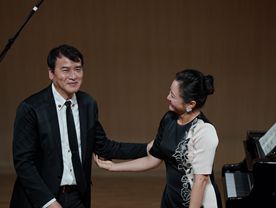
    The School of Music, the Chinese University of Hong Kong, Shenzhen held a chamber concert themed "Summer Journey" at the concert hall of Longgang Cultural Center on Sunday night.Ye Xiaogang, founding dean of the School of Music, delivers a speech at the concert. Photos by Liu XudongThe school's all-star faculty including Chan Wing-Wah, Jin Zhenhong, Yuan Fang, Zhang Jingye and Zhu Yiping together presented a music fiesta to audiences both offline at the concert hall and online through livestreaming.The concert was supported by the publicity department of the Longgang District Government, and organized by the School of Music and the Culture, Radio, Television, Tourism and Sports Bureau of Longgang District. Ye Xiaogang, founding dean of the School of Music, served as the art director of the concert.As the second public concert of the School of Music, the chamber concert was rich in its genres and presentation forms ranging from Western classics to original Chinese music, from instrumental solos to repertoire and vocal solos.Zhang Jingye, renowned violinist and professor of the School of Music, plays the violin while Feng Xiaolin, a freshman at the School of Music, plays the piano.The concert started with "Fratres for Violin and Piano" by Arvo Pärt, performed by Zhang Jingye, renowned violinist and professor of the School of Music, and pianist Feng Xiaolin, a freshman at the School of Music.Yuan Fang, renowned pianist and professor of the School of Music, plays the work "Falling Flowers for Piano" composed by Ye Xiaogang.One highlight of the concert was the premiere of "Falling Flowers for Piano" performed by Yuan Fang, renowned pianist and professor of the School of Music. The work, composed by Ye Xiaogang, was originally created for piano and orchestra and was adapted into a piano solo tailored to the special needs of this performance. It's a delicate piece embedded with the Guangdong musical style and presents the local conditions and customs of Guangdong.Ye Xiaogang congrats Yuan Fang on her performance.Saprano Zhou Ni and vocal coach Zhu Yiping present "Banalites for Soprano and Piano."

    SMBU welcomes over 400 freshmen

    08 16, 2021

    window.__styleInject__ = window.__styleInject__ || function (css) { if (!css) return; if (typeof (window) == 'undefined') return; var style = document.createElement('style'); if ('styleSheet' in style) { style = document.createElement('div'); style.innerHTML = 'x' + css + ''; style = style.lastChild; } else { style.innerHTML = css; } var head = document.getElementsByTagName('head')[0]; head.appendChild(style); return css; }; window.__resetPlayerOpt__ = window.__resetPlayerOpt__ || function (opt) { opt.width = opt.width ? (opt.width + '') : '100%'; opt.height = opt.height ? (opt.height + '') : '300px'; if (opt.width.indexOf('%') === -1 && opt.width.indexOf('px') === -1) { opt.width = opt.width + 'px'; } if (opt.height.indexOf('%') === -1 && opt.height.indexOf('px') === -1) { opt.height = opt.height + 'px'; } if (!!window.navigator.userAgent.match(/AppleWebKit.*Mobile.*/)) { if (opt.custom_priority) { if (opt.width && typeof opt.width === 'string' && opt.width.indexOf('%') > -1) { window.__styleInject__('div#' + opt.id + '.prism-player.video.nfw-cms-video { width: ' + opt.width + ' !important; height: ' + opt.height + ' !important; }'); } else { var __pdom = document.getElementById(opt.id); var pwidth = __pdom.parentElement.offsetWidth || document.body.offsetWidth; opt.height = window.parseInt(opt.height) / window.parseInt(opt.width) * pwidth + 'px'; opt.width = '100%'; window.__styleInject__('div#' + opt.id + '.prism-player.video.nfw-cms-video { width: ' + opt.width + ' !important; height: ' + opt.height + ' !important; }'); } } else { opt.width = '100%'; } } else { if (opt.custom_priority) { window.__styleInject__('div#' + opt.id + '.prism-player.video.nfw-cms-video { width: ' + opt.width + ' !important; height: ' + opt.height + ' !important; }'); } } return opt; }; window.__cms_video_player_instances__ = window.__cms_video_player_instances__ || []; window.__cms_viedo_player_opts__ = window.__cms_viedo_player_opts__ || []; var playerOpt = {"id":"video_4658178772302657","source":"{\"LD\":\"https:\\\/\\\/gdvideo.southcn.com\\\/9368011946064e609d83e36d0661215a\\\/b8c499bed4bd49d3961f88c200daca8f-d41ba070013347e58b470397698ca252-ld.mp4\",\"SD\":\"https:\\\/\\\/gdvideo.southcn.com\\\/9368011946064e609d83e36d0661215a\\\/b8c499bed4bd49d3961f88c200daca8f-803fdfc388b0f26bdc288df688edb86f-sd.mp4\"}","qualitySort":"asc","format":"mp4","mediaType":"video","cover":"https:\/\/www.lg.gov.cn\/video\/0\/3\/3499\/9063405_ad21a4.jpeg","autoplay":false,"isLive":false,"rePlay":false,"playsinline":true,"preload":false,"language":"zh-cn","controlBarVisibility":"hover","useH5Prism":true,"custom_priority":false,"height":"540px","width":"100%","custom_height":"0px","custom_width":"0px"}; playerOpt = window.__resetPlayerOpt__(playerOpt); if (!window.addEventListener) { playerOpt.useFlashPrism = true; } else { playerOpt.useH5Prism = true; playerOpt.cover = "https://www.lg.gov.cn/video/0/3/3499/9063405_ad21a4.jpeg"; } window.__cms_video_player_instances__.push(new Aliplayer(playerOpt)); window.__cms_viedo_player_opts__.push(playerOpt);

    SMBU's commencement ceremony

    07 15, 2021

    window.__styleInject__ = window.__styleInject__ || function (css) { if (!css) return; if (typeof (window) == 'undefined') return; var style = document.createElement('style'); if ('styleSheet' in style) { style = document.createElement('div'); style.innerHTML = 'x' + css + ''; style = style.lastChild; } else { style.innerHTML = css; } var head = document.getElementsByTagName('head')[0]; head.appendChild(style); return css; }; window.__resetPlayerOpt__ = window.__resetPlayerOpt__ || function (opt) { opt.width = opt.width ? (opt.width + '') : '100%'; opt.height = opt.height ? (opt.height + '') : '300px'; if (opt.width.indexOf('%') === -1 && opt.width.indexOf('px') === -1) { opt.width = opt.width + 'px'; } if (opt.height.indexOf('%') === -1 && opt.height.indexOf('px') === -1) { opt.height = opt.height + 'px'; } if (!!window.navigator.userAgent.match(/AppleWebKit.*Mobile.*/)) { if (opt.custom_priority) { if (opt.width && typeof opt.width === 'string' && opt.width.indexOf('%') > -1) { window.__styleInject__('div#' + opt.id + '.prism-player.video.nfw-cms-video { width: ' + opt.width + ' !important; height: ' + opt.height + ' !important; }'); } else { var __pdom = document.getElementById(opt.id); var pwidth = __pdom.parentElement.offsetWidth || document.body.offsetWidth; opt.height = window.parseInt(opt.height) / window.parseInt(opt.width) * pwidth + 'px'; opt.width = '100%'; window.__styleInject__('div#' + opt.id + '.prism-player.video.nfw-cms-video { width: ' + opt.width + ' !important; height: ' + opt.height + ' !important; }'); } } else { opt.width = '100%'; } } else { if (opt.custom_priority) { window.__styleInject__('div#' + opt.id + '.prism-player.video.nfw-cms-video { width: ' + opt.width + ' !important; height: ' + opt.height + ' !important; }'); } } return opt; }; window.__cms_video_player_instances__ = window.__cms_video_player_instances__ || []; window.__cms_viedo_player_opts__ = window.__cms_viedo_player_opts__ || []; var playerOpt = {"id":"video_51340580498770420","source":"{\"LD\":\"https:\\\/\\\/gdvideo.southcn.com\\\/99d1516fc3fd45c6b55a75e3a0d6724c\\\/1713a88432c848dd8b9f01a9c9ef8b9c-dd6acdfb7a257e5f20516a84b16b5891-ld.mp4\",\"SD\":\"https:\\\/\\\/gdvideo.southcn.com\\\/99d1516fc3fd45c6b55a75e3a0d6724c\\\/1713a88432c848dd8b9f01a9c9ef8b9c-f2c073606eacb37aac9c8f0400e119bc-sd.mp4\"}","qualitySort":"asc","format":"mp4","mediaType":"video","cover":"https:\/\/www.lg.gov.cn\/video\/0\/3\/3243\/8981012_5f1410.jpeg","autoplay":false,"isLive":false,"rePlay":false,"playsinline":true,"preload":false,"language":"zh-cn","controlBarVisibility":"hover","useH5Prism":true,"custom_priority":false,"height":"540px","width":"100%","custom_height":"1080px","custom_width":"1920px"}; playerOpt = window.__resetPlayerOpt__(playerOpt); if (!window.addEventListener) { playerOpt.useFlashPrism = true; } else { playerOpt.useH5Prism = true; playerOpt.cover = "https://www.lg.gov.cn/video/0/3/3243/8981012_5f1410.jpeg"; } window.__cms_video_player_instances__.push(new Aliplayer(playerOpt)); window.__cms_viedo_player_opts__.push(playerOpt);

    Revolutionary sites with a red history

    07 06, 2021

    Visitors at the Dongjiangchao Red Culture Museum in Longgang District. Photos by Sun YuchenDuring the Chinese People's War of Liberation, the Kuomintang triggered battles in Guangdong to eliminate troops led by the Communist Party of China (CPC). In February 1947, the Huidongbao People's Guarding Regiment was founded to fight against the Kuomintang. The Jiangnan Detachment of the regiment organized three battles in Shayuchong, Shanzixia and Honghualing in today's Longgang District in July and August 1948.In memory of the great achievements of revolutionary martyrs in Longgang, the 18.6-meter-tall Longgang People's Revolutionary Martyrs Monument was erected in the Honghualing Revolutionary Memorial Park in 2004. The names of 542 revolutionary martyrs during the Nationalist Revolution, the Agrarian Revolutionary War, the Chinese People's War of Resistance Against Japanese Aggression, the Chinese People's War of Liberation, the Socialist Revolution and Socialist Construction had been inscribed.The Longgang People's Revolutionary Martyrs Monument in the Honghualing Revolutionary Memorial Park.Also in Longgang, the Dongjiangchao Red Culture Museum built in 2019 houses more than 2,000 items including 300 revolutionary items, such as documents, publications, albums, badges and weapons, covering the time period from the May Fourth Movement in 1919 to the founding of the People's Republic of China in 1949.At the Dongjiangchao Red Culture Museum, an information board on the left introduces the Sanzhoutian Uprising led by Sun Yat-sen in 1900 in Shatoujiao, today's Yantian District. The uprising is known as the start of China's democratic revolution against the imperial court of the Qing Dynasty (1644-1911). Another information board on the right displays photos (in clockwise) of Huang Xuezeng, Yin Linping, Wang Zuoyao and Zeng Sheng. Huang was one of the founders of the CPC Bao’an organization; Yin was a leader of the CPC organization in the Dongjiang area; Zeng and Wang were founders of the Dongjiang Column of Guangdong People's Guerilla Force Against Japanese Aggression.A hall in the museum takes inspiration from the iconic Central Auditorium in Yan'an, a former revolutionary base of the CPC, making use of the arched structure of cave dwellings to give the hall a sense of prestige.A Mauser pistol used by the Red Army during the Long March (1934-1936) is exhibited at the Dongjiangchao Red Culture Museum.A figurine of Norman Bethune is on display at the Dongjiangchao Red Culture Museum. The surgeon led a Canadian medical team to China in early 1938 to help the Chinese people fight against Japanese invaders and sacrificed his life in 1939.A hall in the Dongjiangchao Red Culture Museum takes inspiration from the iconic Central Auditorium in Yan'an, a former revolutionary base of the CPC.An exhibition wall at the Dongjiangchao Red Culture Museum introduces the past national congresses of the CPC.

    Revolutionary sites with a red history

    06 09, 2021

    On Xiangshan Road in Shanxia Community, Pinghu Subdistrict, Longgang District, there used to be ancestral halls which were built in 1885 for the Yan and the Ye families. In the first half of the 20th century, the traditional Guangdong houses witnessed Pinghu people's indomitable spirit and the area's revolutionary history.The Shanxia Museum of Revolutionary History is located in Pinghu, Longgang District. Photos by Sun Yuchen except otherwise statedIn the Nationalist Revolution (1924-1927), a vigorous anti-imperialism, anti-feudal warlord revolutionary movement, a peasant association and a peasant self-defense troop were formed in February 1926 in Shanxia to fight against feudal landlords.Information and old photos on the history of the CPC Shanxia branch.In May 1926, the Communist Party of China (CPC) organization in Dongguan sent Cai Ruping to set up Shenzhen's first CPC village branch at the ancestral halls. Yan Kaixiang was elected as the first secretary and 17 aspiring youngsters in Shanxia Village became CPC members.Sculptures of revolutionaries on display inside the Shanxia Museum of Revolutionary History. Photo from WeChat account "lgrm6666"During the revolution, Yan Zhongxi, the second secretary of the CPC Shanxia branch, organized CPC members and villagers to plant fruits and farm produce both to disguise their revolutionary actions and to support their living.In the Chinese People's War of Resistance Against Japanese Aggression (1931-1945), Pinghu was the main revolutionary base for the Dongjiang Column of Guangdong People’s Guerrilla Against Japanese Aggression. The ancestral halls also served as the temporary headquarters of the troop led by Wang Zuoyao, deputy commander of the Dongjiang Column.The Shanxia Blockhouse built in 1907, near the Shanxia Museum of Revolutionary History, used to be an intelligence station for the CPC Shanxia branch. Photo from WeChat account "lgrm6666"Under the leadership of the CPC, people in Pinghu actively joined the army. Fourteen villagers from the small village of Hongzhuling joined the Dongjiang Column, while more than 10 Shanxia people sacrificed their lives for the national independence and liberation.Shanxia Revolutionary Martyrs Monument.Profiles of martyr Cai Masheng, CPC officials Liang Zhong and Liang Lian and soldier Cai Guijin. They were all from Shangmugu Village in Longgang District.From 2005 to 2009, the ancestral halls were refurnished and turned into the Shanxia Museum of Revolutionary History, covering 360 square meters. Near the museum, a 6.3-meter-tall monument, erected in 1984, is inscribed with the words "Shanxia Revolutionary Martyrs Monument" written by Wang. Names of 17 Shanxia martyrs during the wars from 1924 to 1949 are also inscribed on the monument to commemorate their bravery and glory.An exhibition on Shanxia's revolutionary history outside the Shanxia Museum of Revolutionary History.

    Revolutionary site with a red history

    06 01, 2021

    An entrance to Gankeng Hakka Town. Photos by Sun YuchenThe popular Gankeng Hakka Town in Longgang District used to be a village where Hakka people lived more than 350 years ago. With many old Hakka buildings still preserved, Gankeng is regarded as one of the 10 old Hakka villages in Shenzhen. Now, the town has become a comprehensive scenic spot for visitors to experience Hakka culture and folk customs and taste various delicacies there.Gankeng Blockhouse is located inside Gankeng Hakka Town.In the early 1900s, bandits and thieves were rampant in Gankeng and after several fights between villagers and bandits, the Gankeng Blockhouse was built by Peng Zhenfang, a well-off villager, in 1921 as a shelter for villagers.A traditional Hakka house interior scene, with a screen showing the revolutionary history in Gankeng, is on display inside Gankeng Blockhouse.During the Chinese People's War of Resistance Against Japanese Aggression (1931-1945), Zeng Sheng, chief commander of the Huibao People's Guerrilla Against Japanese Aggression (former Dongjiang Column of Guangdong People's Guerrilla Against Japanese Aggression), encouraged Gankeng people to join the Communist Party of China and fight against Japanese invaders.When Zeng was injured in a battle, he received medical treatment in Gankeng secretly and during the war, eight villagers-turned-soldiers from Gankeng sacrificed their lives and were titled martyrs.Profiles of eight Gankeng martyrs during the Chinese People's War of Resistance Against Japanese Aggression are on display inside Gankeng Blockhouse.Later, the Dongjiang Column helped villages in Shenzhen to form guarding troops and in Gankeng, a troop of more than 10 villagers had transmitted intelligence information many times to Chinese guerrillas.Information and old items recording the revolutionary history in Gankeng are on display inside Gankeng Blockhouse.The Gankeng Blockhouse embodies Gankeng Hakka people's indomitable spirit to resist foreign aggression.A bird's-eye view of Gankeng Hakka Town in Longgang District.